
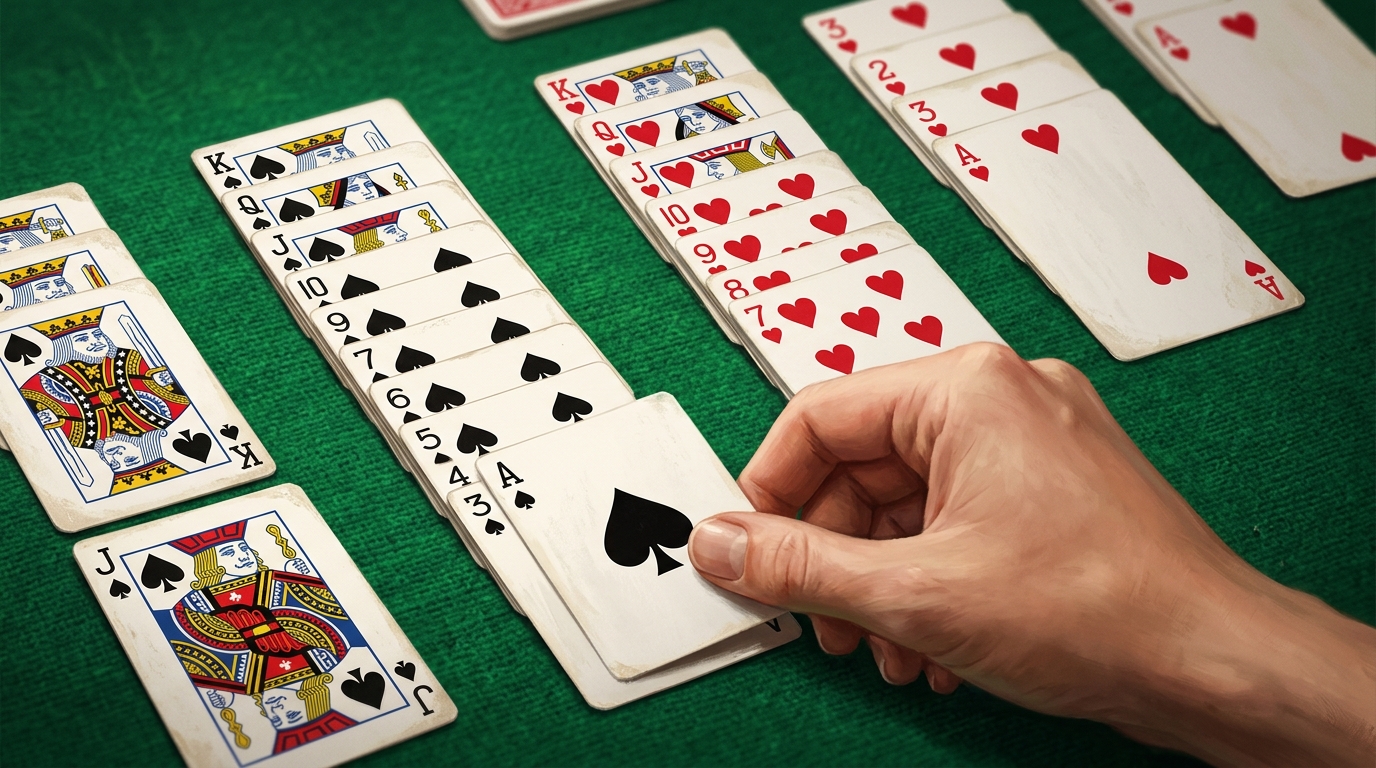
Spider Solitaire 2 becomes easier to enjoy once the rules are treated as information rather than obstacles. Two suits are forgiving enough to teach planning while still making a careless move visible a few turns later. The goal is not to memorize every advanced trick. It is to understand what a legal move reveals, what it closes, and when a tempting shortcut creates a harder board. A few plain habits can make the next session feel more readable without taking away the discovery.
Spider Solitaire 2 in practice
Two suits are a lesson in controlled risk
Two-suit Spider is easier to read than four-suit play, but it is not automatic. The main goal is still to build descending runs and complete a same-suit sequence from King to Ace. The extra suit means a move may be legal while still being strategically poor. You can place a card and create a prettier column, yet bury the one card that would have opened a hidden deal.
The useful question is not only ‘Can I move this?’ It is ‘What does this move reveal, and what does it make harder?’ That change in wording is the beginning of stronger Spider play.
Empty columns are temporary tools
An empty column can hold a useful run, expose a hidden card, or separate suits that are blocking one another. It can also be filled too early. If a player drops the first legal card into the space, the board may look tidy while losing the flexibility that made the empty column valuable. Keep the lane open when it can support a larger repair move.
Stock deals should also wait until the visible tableau has been squeezed for useful changes. Drawing early adds cards before the board has given you every available option.
Use the mode to practice the decision
Play Spider Solitaire on the main site and find more Spider strategy on this site. Microsoft’s Solitaire history explains why these modes became familiar, and the Spider Solitaire rules overview) is a useful reference when comparing suit counts.
A clean checklist for the next game
Before making a move, count the useful spaces on the board. Empty columns, reachable face-down cards, and same-suit runs are not equal, but they are all forms of leverage. A move that preserves two of them may be stronger than a move that creates one attractive stack. This is why Spider often rewards restraint even when several legal moves are available.
Mixed-suit stacks deserve special attention. They can move, but they usually cannot be treated as one clean unit until the suits align. If you move one too early, you may bury a card that would have repaired another column. Try to expose information before you rearrange the visible surface.
Treat the stock as a commitment. Once a deal adds cards to every column, the board may lose the clean spaces you were protecting. Use the visible tableau first, then deal when the remaining moves are genuinely limited. After the deal, pause and identify the new longest run, the new blocked column, and the card that became reachable.
For the next session, play a Spider board on Easy Daily Puzzle and browse more Spider Solitaire strategy on this site. A good review asks which move reduced future choices. That question improves planning more reliably than simply replaying the same board until it finally works.
The small detail worth remembering
The strongest Spider move is often the one that improves the next three moves rather than the one that looks best immediately. Empty columns, hidden cards, and same-suit runs are resources. Spend them when the board gives you a clear return.
A loss can still be a good session if it reveals the cost of one decision. Review the first moment when the tableau became less flexible, then enter the next deal with that specific warning in mind. Planning grows from concrete mistakes.
When several moves look legal, choose the one that reveals the most information while preserving the most space. That single filter removes many attractive but unhelpful clicks.
For a little more context, read Microsoft’s history of Solitaire on Windows and Spider Solitaire background. These references are useful for checking the basic history or rules without turning a daily game post into a long reference list.